
How to summarise a long document with AI and check what it left out
A summary is useful until it leaves out exactly what you needed to know. How to write the instruction and check in a few minutes whether anything is missing.
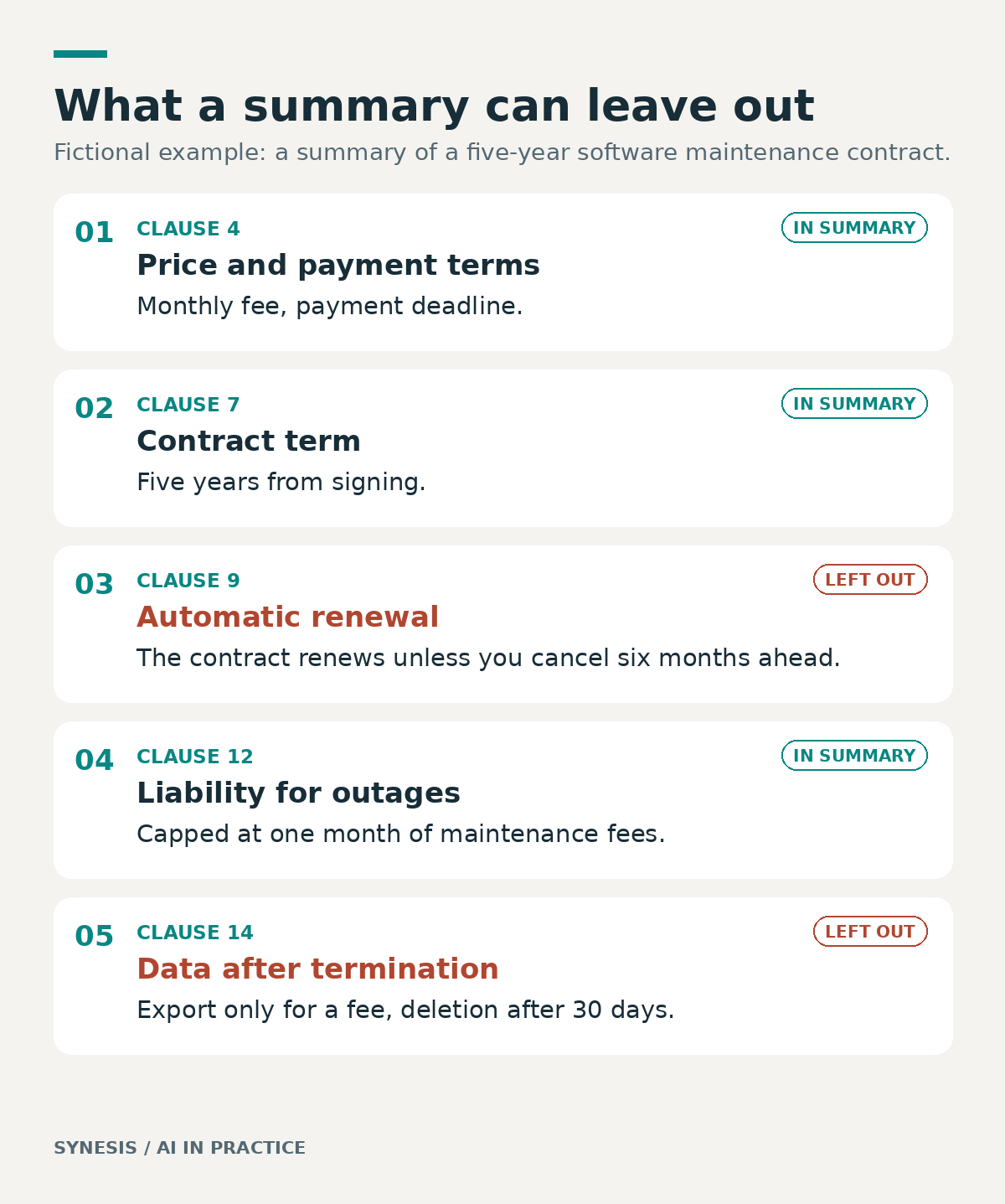
A long contract, report or policy is easier to digest as a summary. AI writes one in seconds and it reads smoothly. The risk is not necessarily a wrong fact. More often something you would have cared about is missing, and you do not notice because you cannot see it.
A summary is a shorter version of the document, so something has to drop out. The question is whether it was something minor or exactly what you needed to know before signing.
Tell the AI why you are reading the document
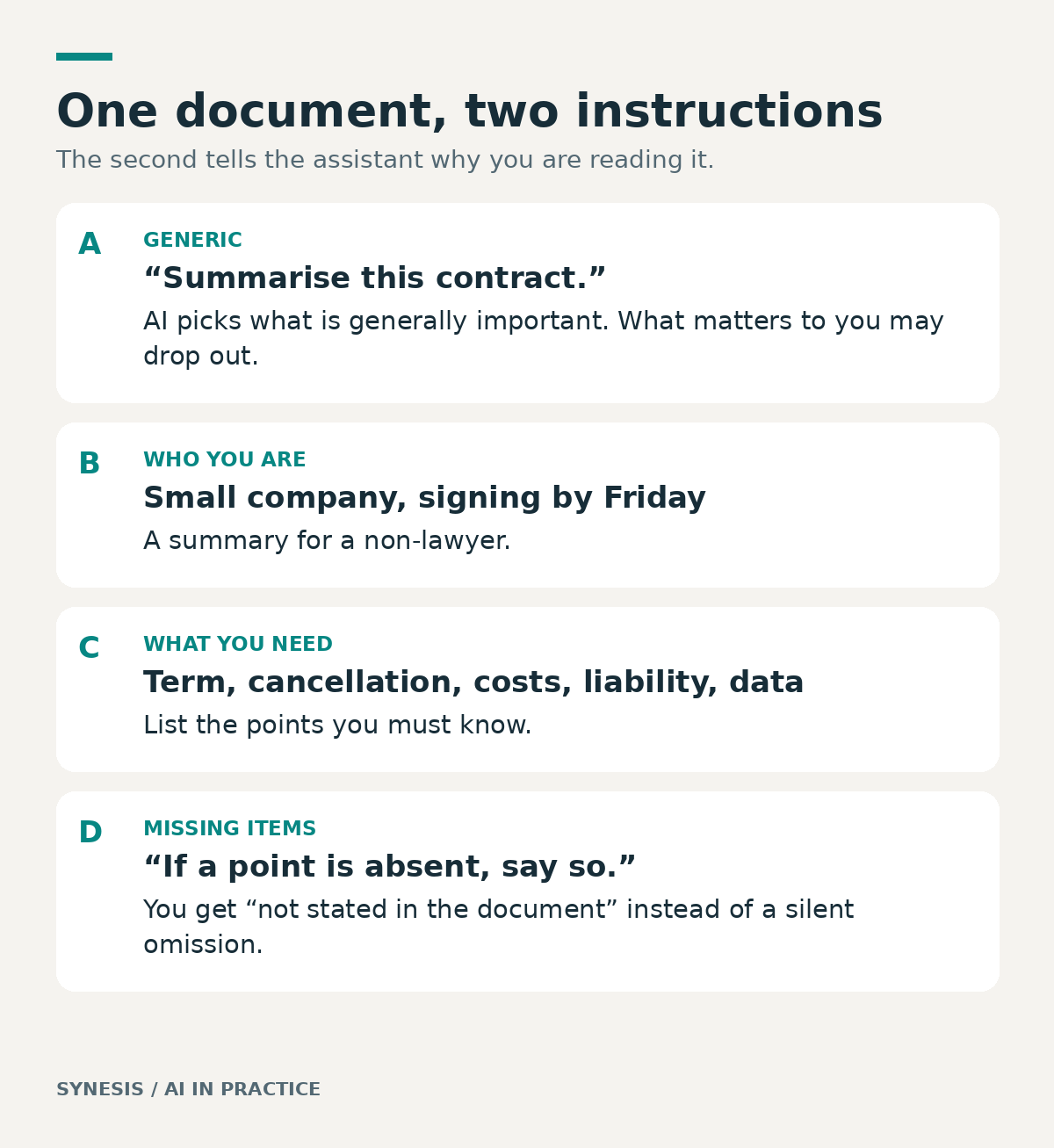
The instruction “Summarise this contract” does not say what matters to you, so the assistant picks what looks generally important. It works better to say who you are and what you are deciding.
Say you have a five-year software maintenance contract to sign by Friday. This is a fictional example, and the instruction could look like this:
The attached contract is for software maintenance. We are a small company and must sign by Friday. Summarise it for a non-lawyer. I am particularly interested in: the term and renewal, the notice period, all costs beyond the base price, the provider's liability during outages, and what happens to our data if the contract ends. If any of these points is not in the document, say so explicitly.
The last sentence matters. Without it, AI often just skips a missing point. With it, you get a clear “not stated in the document”.
Ask for the clause or page
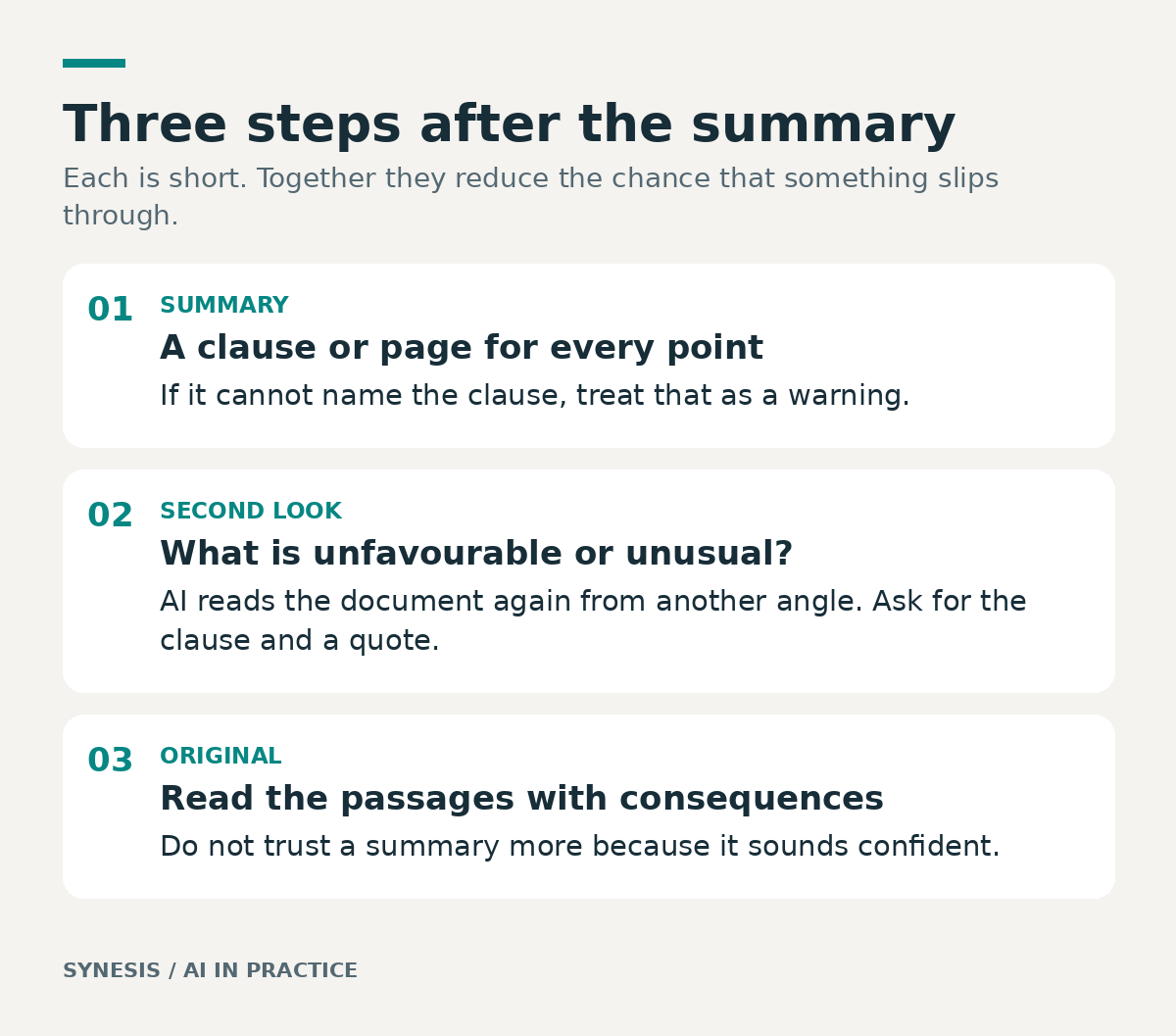
For every point in the summary, ask the AI to name the clause or page where it found it. That way you read four or five passages instead of the whole document. If it cannot name the clause, you have probably received a general explanation of similar contracts, not a reading of yours.
Ask what it left out
Once you have the summary, ask one more question:
Which provisions in this document are unfavourable to the customer, unusual, or different from typical contracts of this kind? Give the clause and a short quote.
The AI reads the document again from another angle and often finds things the first summary lacked. This does not guarantee completeness, but it is a cheap second opinion.
Read what has consequences yourself
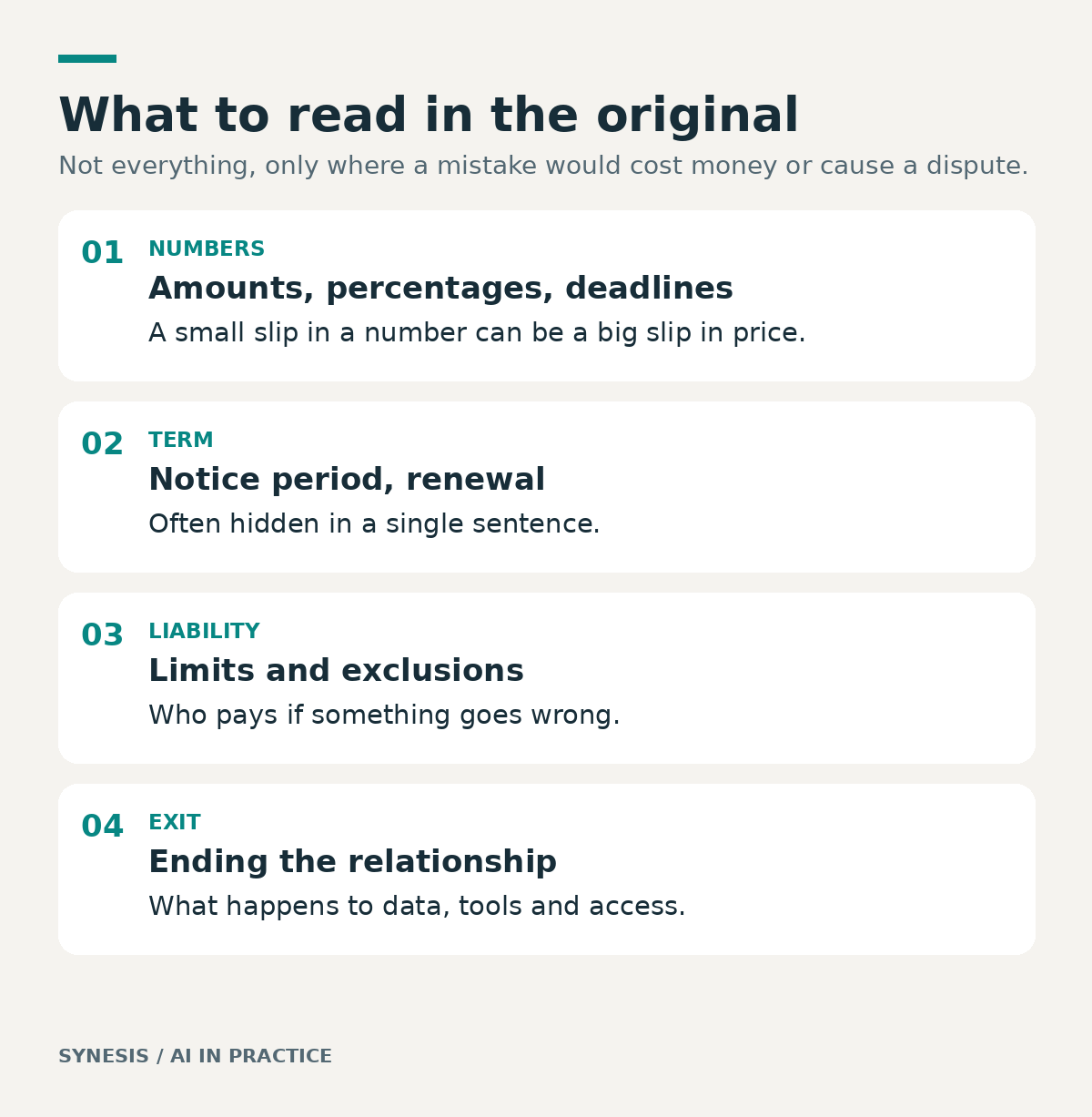
You do not need to read everything. Read the passages with consequences in the original:
- Amounts and deadlines: a small slip in a number can be a big slip in price.
- Notice period and renewal: often hidden in a single sentence.
- Limits of liability: who pays if something goes wrong.
- Ending the relationship: what happens to data, tools and access.
If the summary and the original differ, the original governs.
Bring in a person when the stakes are high
For a contract with large consequences, an AI summary is good preparation for a conversation with a lawyer, not a replacement for one. Prepare a list of questions and marked clauses, and the lawyer can review them faster.
Also think about what you upload. Contracts and reports often contain personal or confidential data, so check that first. More in the guide What to tell AI and what to keep private. For checking answers in general, see AI sounds convincing. How do you check if it is right?
Want to try this with your team? I build workshops on examples from your own work.
See the workshops